中文
中文 English

On the exterior walls of buildings, you may often see some high-altitude workers cleaning the glass. The black glass exterior walls reflect strong light like a mirror. This is what is called one-way vision glass. Many people think that one-way vision glass is mainly used in observation rooms or some important business clubs. It is feasible to use it at home, but the price is too high for them to afford.
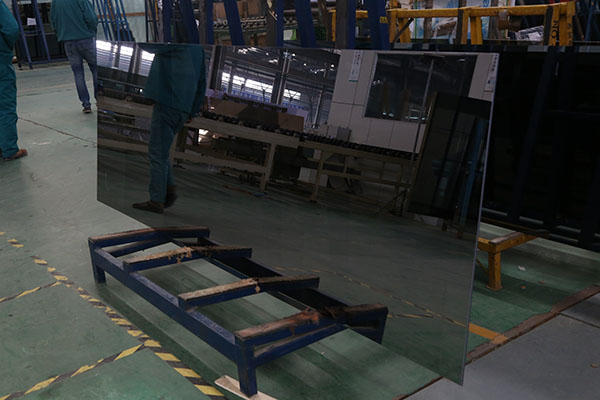
Due to the wide application of one-way vision glass, high-quality imitation one-way vision effects have also become popular in the market, that is, one-way vision films. They look similar to the text on one-way vision glass, but the structure they function with is different. One-way vision film is a type of film that imitates one-way vision glass. The key point and essence lie in the film itself. It achieves the function of one-way vision through the principle of one-way transparency and can achieve a certain degree of effect in terms of functional effect.
Since there is such a simple method, then why are all the builders and construction workers in the market still using one-way vision glass? This has to start with the performance of one-way vision glass and the production of one-way vision films.
One-way vision glass is made by applying the principle of one-way transparency to the glass. Through precise processing techniques, it is integrated into the glass itself to create a one-way transparency effect. Generally, one-way vision glass is tempered glass, which to a certain extent will not be easily broken by impact. Moreover, each layer of the glass structure is semi-transparent. So the semi-transparent effect appears very good.
Unidirectional transparency film is applied to the film based on the principle of unidirectional transparency. It adheres to the surface of the glass through the adhesion of the film and the glass. In fact, only the film has transparency. The glass only presents double-sided transparency. When the glass and the film are combined, the effect is demonstrated.
Compared with one-way vision film and one-way vision glass, we can take a real mobile phone and a children's mobile phone model as examples. They can achieve the same effect in appearance, but they cannot realize all the functions of a real mobile phone in terms of function.